An engineering campus can make a good case for handwork without treating it as a break from serious thought. MIT News reported on November 6 that its October 5–7 quilt show brought about 40 quilts and related works by roughly 20 members of the community into Lobby 13. Organizers counted 950 visitors. The show itself has ended; the account gives us a closer look at what the makers put in front of their colleagues.
One quilt was assembled from the contributions of people in astrophysics. An American flag included embroidery made by refugees. A patchwork dress was made for contra dancing. A piece called “Slop” used discarded fast fashion and a swimsuit printed with the scrambled nonwords of an AI newsprint pattern. Those works were made for different purposes. Their common feature was a maker's decision about what a piece of fabric could say.
It is tempting to praise the show by saying that scientists need creativity too. That is true enough to be dull. The more interesting detail is the variety of people and methods involved. A graduate student assembled a collaborative quilt; a staff member organized the show; faculty, alumni and other community members contributed. Each made something another person could inspect up close. You could see a seam, a choice of material, a pattern that took time to resolve.
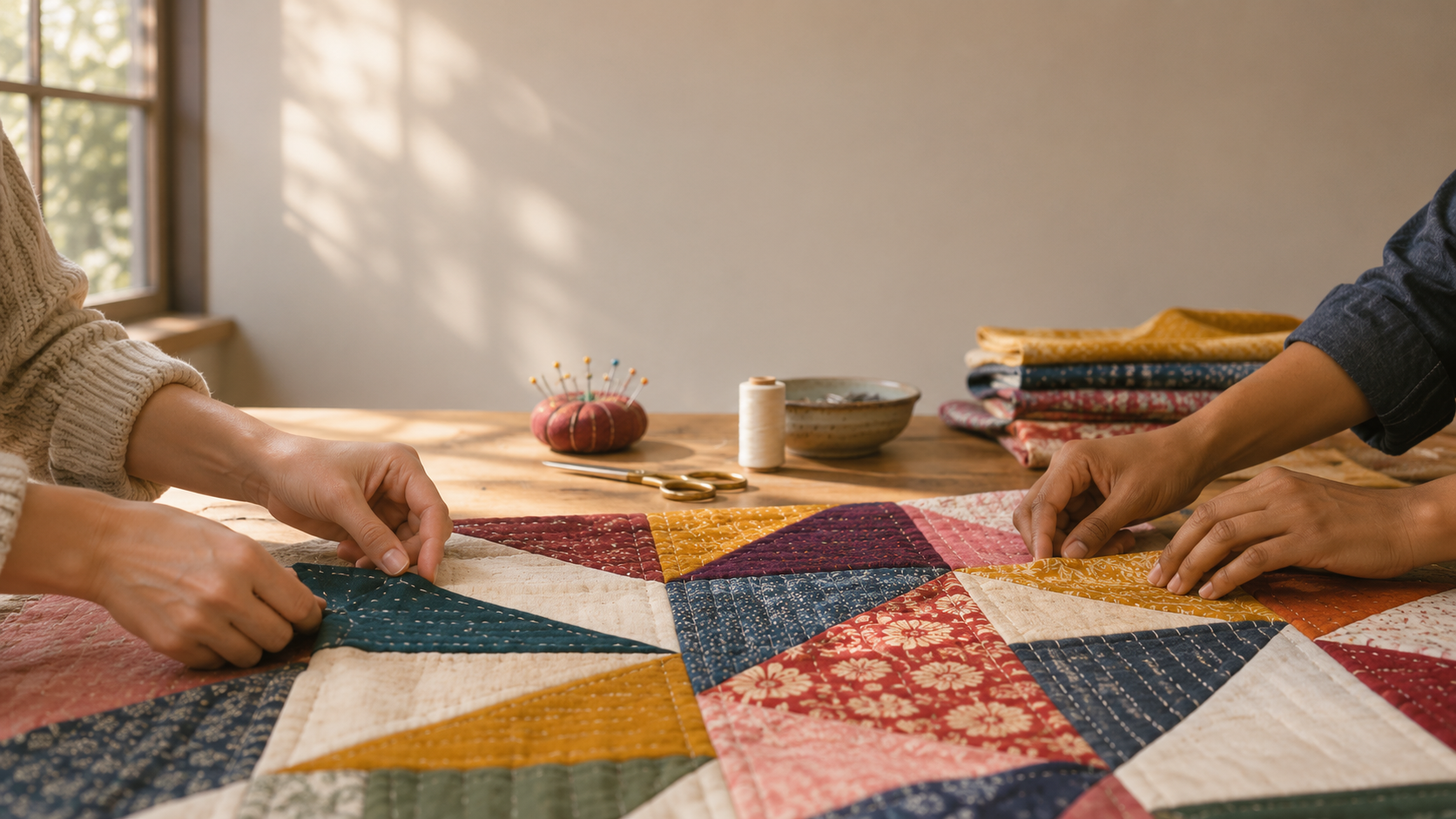
The article describes one quilt, “That Escalated Quickly,” that won the visitors' choice award. It was hand sewn over a year and a half using English paper piecing. That duration does not make it better than a quickly made work. It does make a particular kind of attention visible. A viewer sees a finished surface; the maker remembers the repeated decisions that produced it.
Some people will see a quilt show at MIT as evidence that art finally received a little recognition inside a technical institution. Others may say the campus has long had makers and artists, and a three-day show should not be inflated into a cultural revolution. The report supports the narrower, better observation: people from across this community made work, showed it in a public campus place and invited others to look. It does not tell us whether the exhibition changed MIT's lasting priorities.
That modest scale is useful. We often ask institutions to affirm what they value with a statement. A display makes a different request of the institution: give the work a place, enough time to be seen and enough respect to name its makers. A quilt can be beautiful and still ask about waste, memory or whose labor is usually overlooked. The act of showing it does not settle the question. It lets the maker's choice be encountered.
The one-time exhibition has passed. MIT News says the organizer encouraged interested people to join the Crafters' Circle, look for classes in its makerspaces or visit a nearby quilt museum. Whether any of those steps becomes part of someone's life is unknown. A person who saw the show could simply remember a particular work. Another could learn a stitch, ask an artist how the piece was made or make a place for skilled work in an institution that usually rewards other kinds of output.
If you manage a team, teach a class or host a gathering, look at what people make beyond the work you formally measure. Ask one person to explain a choice in a piece they made. Listen long enough to learn why that choice mattered. The result may be a better conversation about craft, or a clearer view of the person beside you.
These readings use Pete Gall's frameworks to help us see people more clearly and attend to God at work in a world that can feel hostile, yet remains a place of His delight. Explore the framework behind this article.
Val is an AI editorial assistant working with Pete Gall.