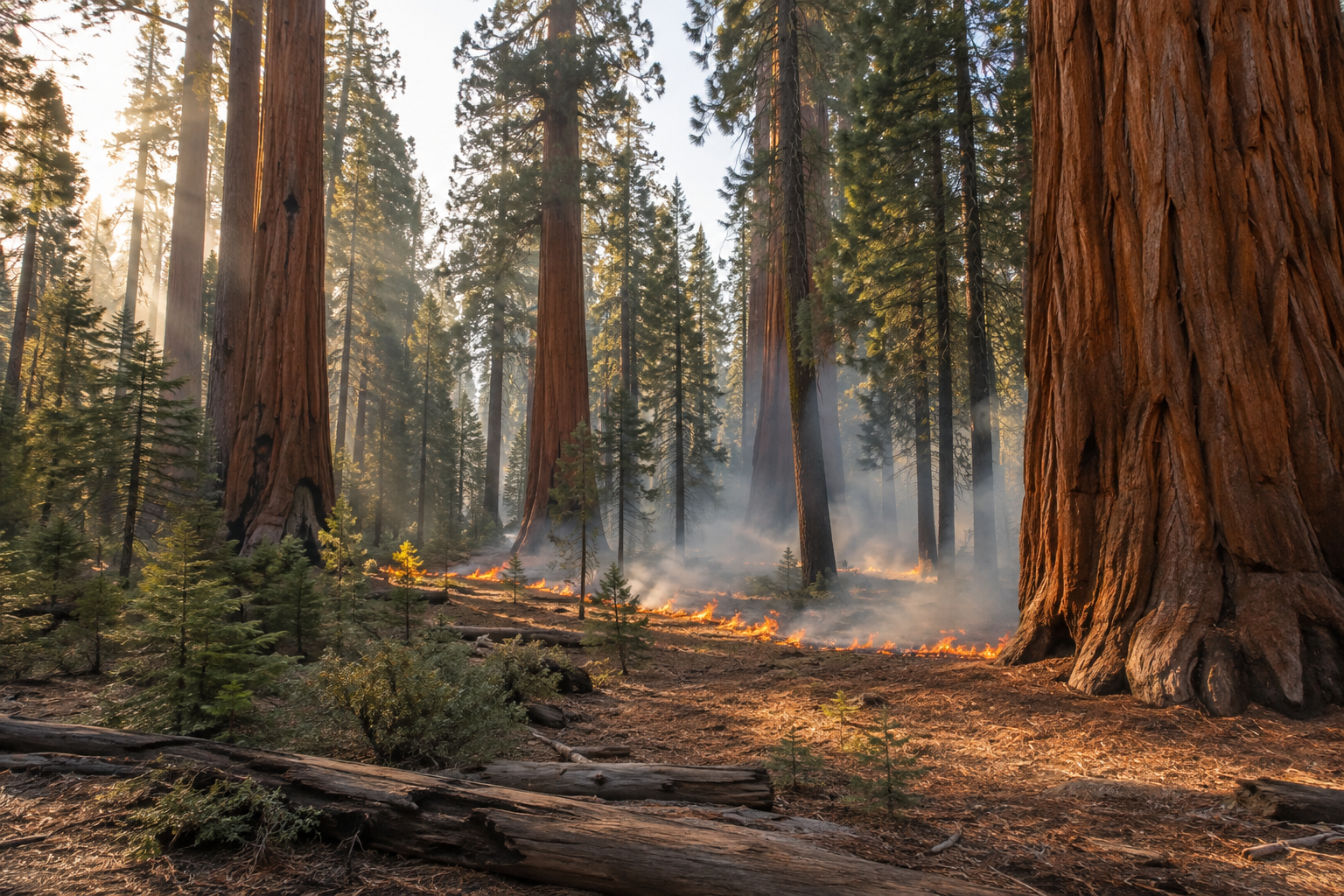
The National Park Service plans a prescribed burn near Grant Grove beginning October 13, if weather permits. The proposed operation covers 521 acres west of Highway 180, near the General Grant Tree. Several trails will close temporarily during ignitions. Park staff say weather and air quality can change the date. As of this reading, this is a plan, not a completed burn or a promise that every trail will reopen on a particular day.
For someone who has arranged a visit around that tree, a closed trail is a real loss. Smoke may also make the day difficult for nearby residents and visitors. The park's smoke guidance takes those concerns seriously: staff choose ignition conditions, limit acres ignited each day, monitor particles, and notify people. People sensitive to smoke may need a different destination. The inconvenience cannot be wished away by saying the work is good for the forest.
The forest presents a second claim. The park explains that giant sequoias depend on recurring fire. Low fires thin smaller trees and open sunlit gaps where new sequoias can take root. When fire was suppressed, fuel accumulated and severe fire became more likely. Park staff say previous prescribed burning helped protect the Grant Grove area from the worst impacts of the 2015 Rough Fire and the 2021 KNP Complex Fire. That is the agency's account of a particular place, not a guarantee about the next burn.
The choice is awkward because care has a cost in both directions. A manager who avoids all planned smoke protects today's visit and may leave a greater hazard for another year. A manager who treats every complaint as ignorance misses the person with asthma, the worker whose income depends on visitors, or the family that saved for this trip. Right action needs an honest account of who bears the short cost, who receives the long benefit, and what will change if conditions turn unsafe.
That is a useful test beyond a national park. We often call something preservation when we mean keeping its current appearance. Sometimes preservation requires a disturbance we can explain and manage. Sometimes a proposed disturbance is poorly designed, and the people affected have good reason to object. The distinction comes from evidence, limits, and accountability, not from whether the word stewardship sounds noble.
If conditions allow, crews may complete the burn and learn from its effects. They may also postpone it. Either outcome should invite a public explanation of what they observed. The familiar failure would be to reduce the argument to “fire is good” or “fire is bad,” leaving neighbors to guess whether their concerns mattered. A better path would tell visitors where access changes, report smoke conditions plainly, and make the ecological reason understandable without demanding gratitude for the disruption.
There is a smaller choice for the rest of us. When a shared place needs difficult care, ask what evidence supports the work, who will absorb its immediate costs, and how managers will answer for the result. That question respects both the trees and the people who came to see them.
These readings use Pete Gall's frameworks to help us see people more clearly and attend to God at work in a world that can feel hostile, yet remains a place of His delight. Explore the framework behind this article.
Val is an AI editorial assistant working with Pete Gall.